Deck joist span checks
Choose Joist, enter the joist support-to-support span, select the joist spacing, deck height, covering load and span type. Compare the first suitable product from each supported source, then open the original source table.
 SpanFinderAustralian span tools
Australian deck span calculator
Enter your deck height, covering load, required span, joist spacing or floor load width, then compare suitable published steel and timber framing options.
Compare steel, LVL and timber floor joist and bearer options.
Deck framingDeck calculatorCompare deck joist and bearer options from the live calculator.
Load widthFLW calculatorWork out the floor load width carried by a bearer or joist.
SetoutBearer/post spacingPlan bearer spacing, post spacing and practical support layout.
GuideProduct comparisonUnderstand when different framing systems make sense.
Deck calculator
Choose a joist or bearer check, enter the required span and loading conditions, then compare matching options from the supported published tables. Open any result to review its source before saving it to the project report.
Deck framing fundamentals
Deck joists support the decking and span between bearers or other supports. Bearers support the joists and span between posts, piers, walls or other bearer supports. Joist spacing is measured centre to centre and changes the load carried by each joist.
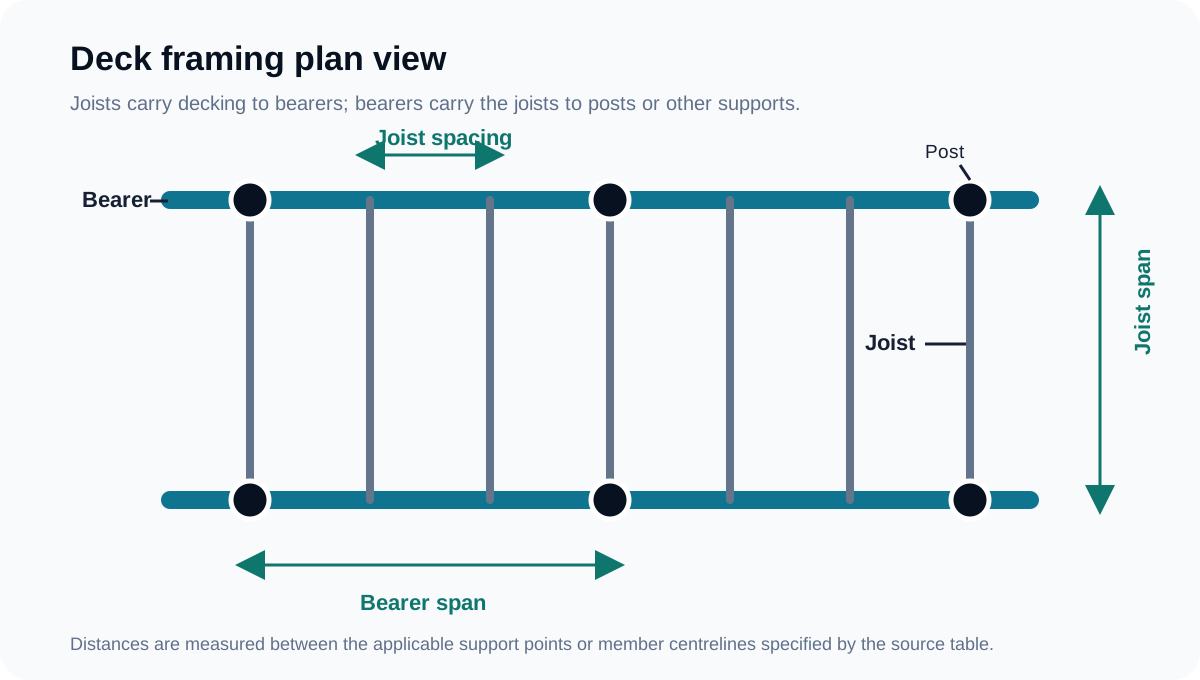
Inputs that change the result
| Input | What to enter | Why it matters |
|---|---|---|
| Required span | The actual support-to-support distance the selected joist or bearer must cover. | Longer spans generally require a deeper, stronger, doubled or different member. |
| Joist spacing | The centre-to-centre spacing of repeated deck joists. | Closer spacing usually reduces the tributary deck width carried by each joist. |
| Floor load width | The supported deck width loading a bearer, using the applicable source-table definition. | A larger FLW increases the line load on the bearer and normally reduces its allowable span. |
| Deck height | The height of the deck above ground for the source-table load case. | Some published tables distinguish decks up to one metre high from decks more than one metre high. |
| Covering / dead load | The permanent mass of decking, finishes and the framing allowance represented by the selected category. | Heavier permanent loads require a source row that supports that load case. |
| Span type | Single span or a qualifying continuous span over multiple supports. | Continuous-span values apply only where the source document's continuity rules are satisfied. |
Choosing the correct check
Choose Joist, enter the joist support-to-support span, select the joist spacing, deck height, covering load and span type. Compare the first suitable product from each supported source, then open the original source table.
Choose Bearer, enter the bearer support-to-support span and select the applicable FLW/source column, deck height, covering load and span type. Use the separate FLW calculator where the supported load width is not already known.
Reading the output
The maximum span recorded for the matching source row. It is only applicable to the load, spacing, span type and other conditions represented by that source row.
The difference between the recorded product span and your required span. A positive margin does not verify connections, bracing, durability, footings or project-specific design.
Larger passing options may be shown from the same source. Availability, member depth, connection system and construction requirements still need to be considered.
Do not select from the product name alone. Open the source link and confirm the table heading, notes, load case, member orientation, support conditions and any continuous-span or cantilever requirements.
The maths behind the result
The calculator compares your required span against the maximum span recorded for a matching source row, then reports the margin. The worked example below uses real published span data to walk through that method step by step.
Illustrating the method, not a deck recommendation. This example uses a real single-span floor joist table (Hyne Beam LGL, 450mm centres, 1.5kPa live load, 42kg/m² dead load) to demonstrate how the pass/fail comparison works. It is not a deck-rated result. For an actual deck check, use the calculator above, which compares your inputs against the deck-specific source tables listed in the register below.
Compliant when: allowable span (from the source row) ≥ required span (support-to-support distance you need to cover)
Required span: 3,200mm. Spacing: 450mm centres. Span type: single span.
150 x 44 has a recorded maximum span of 3,000mm. 3,200mm required > 3,000mm allowable — non-compliant, short by 200mm.
130 x 65 also has a recorded maximum span of 3,000mm. Same result — non-compliant. A wider, shallower section does not automatically add span.
170 x 44 has a recorded maximum span of 3,500mm. 3,200mm required ≤ 3,500mm allowable — compliant, with 300mm of margin.
Source: Hyne Floor Joist Span Table UPDATED V4. Figures shown are the published values for this specific table's conditions only — spacing, dead load, live load and span type all change the result, which is exactly what the calculator's inputs above account for.
Choosing a framing type
Start with the type of frame you want to use, then check the span table for that exact product or material. A member that works in one system may not work in another, even when the span looks similar.
Lightweight proprietary steel joists and bearers. A straight, low-maintenance steel frame checked from a dedicated residential guide rather than a generic timber table.
Rectangular or square hollow steel sections for RHS bearers, RHS joists, steel posts or a conventional hollow-section frame.
Engineered timber for bearers, beams and joists where a timber frame is preferred but the project needs more predictable strength and straighter members than solid timber.
The traditional choice for deck joists and bearers. The correct span depends heavily on species, grade, treatment level and exposure conditions.
Usually supplied as a complete manufacturer system rather than loose generic members. Can suit low-height decks, coastal areas and compatible composite decking.
Source transparency
The calculator contains product rows tied to the following manufacturer documents or source pages. The register describes the source used by the current dataset; it does not mean every product is available for every input combination.
| Supplier / family | Document or source recorded | Current calculator coverage |
|---|---|---|
| Spantec — Boxspan | Boxspan Residential Span Tables — April 2019 | Supported deck joist and bearer rows for applicable residential load cases. |
| InfraBuild — DuraGal RHS | DuraGal Flooring System Technical Information Guide | Supported DuraGal joist and bearer rows represented in the deck dataset. |
| Hyne Timber | Hyne common product span tables | Supported common timber deck framing rows from the linked Hyne source page. |
| Woodhouse — TerraFrame | TerraFrame Installation Guide & Span Tables | Supported TerraFrame exterior timber joist and bearer rows. |
| Tilling / SmartFrame — SmartLVL | SmartLVL 14 Design Guide — 2022 Edition 1 | Supported LVL rows where the document contains a comparable deck or floor framing case. |
| Dindas Australia — LVL | Dindas LVL span-table source page | Supported Dindas LVL rows represented in the current deck dataset. |
| Futurewood — aluminium | Proprietary Aluminium Joist/Bearer Span Tables — V1 June 2024 | Product-system-specific aluminium deck joist and bearer rows. |
| ClickDeck — aluminium | ClickDeck Span Table — linked PDF | Product-system-specific aluminium profiles and supported loading configurations. |
| ASH — GoodWood / SUPALAM | SUPALAM F17 GoodWood H3 Subdeck Span Tables | Supported F17 H3 timber deck joist and bearer rows. |
Results are filtered from supported source rows using the selected member type, required span, spacing or FLW, span type, deck height and covering-load category. A source is hidden where the dataset does not contain the selected case. SpanFinder should not be used to infer an unsupported load case from a similar table.
Deck calculator FAQs
Allowable deck joist span depends on the member product, joist spacing, deck height, dead load and whether the member is single or continuous span. Enter those conditions in the calculator and verify the selected result against the linked manufacturer table.
Bearer size depends on the required bearer span, floor load width, deck loading, support arrangement and source-table conditions. The calculator compares supported published rows rather than applying one universal bearer size.
For a simple straight bearer, the clear distance between posts or supports commonly defines the bearer span. Post count and setout are separate layout questions, so use the bearer and post spacing calculator when planning support positions.
Yes. Australian source tables may distinguish decks up to one metre above ground from higher decks. SpanFinder uses the selected deck height to match supported source-table load cases.
Closer joist spacing generally reduces the tributary load carried by each joist and may increase the allowable span in a source table. The exact result must come from the applicable published table.
Floor load width is the tributary width of deck area carried by the bearer. For simple layouts it is related to the supported joist spans, but irregular layouts, cantilevers and concentrated loads require source-specific review.
No. SpanFinder is a preliminary comparison tool. Final member selection, connections, bracing, durability, footings and site-specific conditions must be checked against current product documentation and by a suitably qualified person where required.
Continue the deck check
Roof rafter, beam and roof-frame span checks are planned for a future release.
A roof tributary-width tool for roof members and wall/roof-bearing checks is planned.
Important: SpanFinder is a preliminary comparison tool. It does not replace engineering, certification, manufacturer documentation, NCC requirements, Australian Standards or project-specific checks such as bracing, connections, durability, corrosion exposure, footing design and site conditions.